Why Did Agatha Christie Disappear for 11 Days?
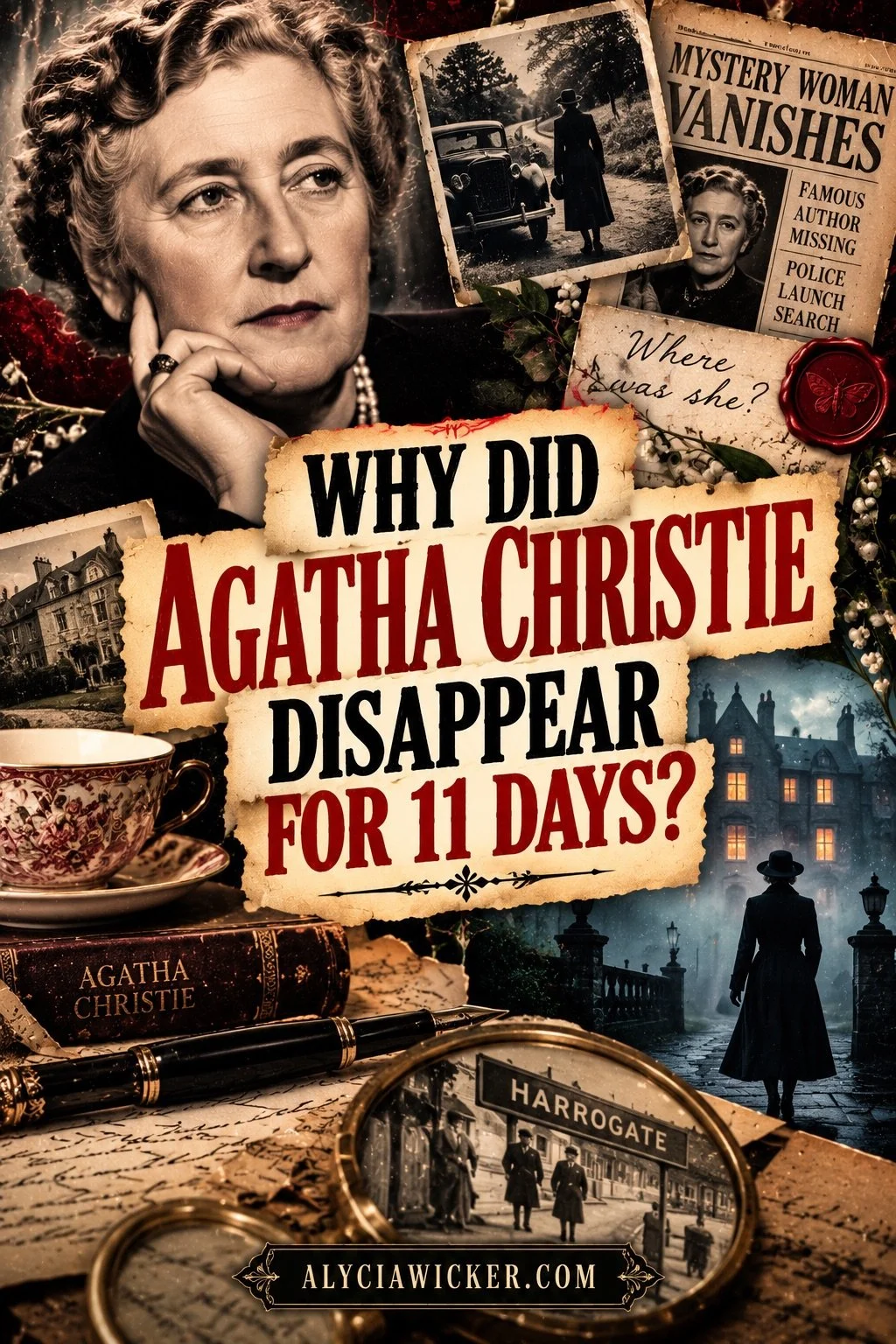
On the night of December 3, 1926, Agatha Christie kissed her seven-year-old daughter goodnight, got into her car and disappeared.
The next morning, her Morris Cowley—fancy-pants car name for those of us who haven’t maintained an encyclopedic knowledge of automobiles that haven’t gotten regular nods in about a hundred years—was found abandoned partway down a grassy slope near a chalk quarry. Agatha wasn’t in it. Her driver’s license was. So was a fur coat, which seems like a fairly shitty thing to leave behind if your plan is to wander around England in December.
Then she stayed missing for eleven days.
Not quietly missing, either. Agatha Christie was already a famous mystery writer, and Britain basically turned into one enormous true-crime Facebook group. Thousands of police and volunteers searched for her. Ponds were searched. Bloodhounds were brought in. Airplanes were used. Newspapers splashed the story across their front pages. People wondered whether she’d killed herself, whether her cheating husband had killed her, or whether the woman who made money writing mysteries had decided to create one in real life.
And because apparently this story wasn’t weird enough yet, Sir Arthur Conan Doyle—the man who created Sherlock Holmes and was deeply involved in Spiritualism—gave one of Agatha’s gloves to psychic Horace Leaf to see if he could pick up where she was.
Which raises an entirely separate question for me because Conan Doyle’s own wife Jean practiced mediumship and automatic writing. So was she unavailable? Did Arthur not trust her with missing mystery writers? Were they in a fight? I have no idea, but somewhere in England the creator of Sherlock Holmes apparently had access to a psychic medium in his own house and still decided, “No, we’re bringing in Horace.”
Everybody get comfortable. We’re going in.
Agatha Was Already Having a Horrible Fucking Year
Before we turn Agatha’s disappearance into a cute little mystery novel where everybody gets cucumber sandwiches at the end, 1926 had kicked the absolute shit out of her.
Her mother, Clara, died that April. Agatha was extremely close to her and was left dealing with her grief while also clearing out the family home. She later described struggling with forgetfulness, crying, insomnia and an inability to cope with ordinary life. At the same time, her writing career was taking off spectacularly. The Murder of Roger Ackroyd came out that year and helped cement her reputation as a major mystery writer.
So professionally? Fabulous.
Personally? Here comes Archie.
Agatha’s husband, Archibald Christie, had fallen in love with another woman named Nancy Neele. He told Agatha he wanted a divorce.
I feel like we’re going to want to remember Nancy’s last name.
The marriage deteriorated, Agatha was grieving her mother, and on December 3 she and Archie reportedly had an argument. Archie then left for the weekend. Agatha left later that night.
And vanished.
Then They Found Her Car
The abandoned car immediately made everything look considerably worse. It had left the road and ended up partway down a slope near a quarry. Some of Agatha’s belongings remained inside, but she was nowhere around. Police now had a missing woman, an abandoned vehicle and a husband who had recently told that missing woman he wanted to leave her for somebody else.
Archie, congratulations. You have unlocked Side-Eyed Husband in the First Twenty Minutes of Dateline status.
Police considered suicide. The public considered murder.
And Archie.
Especially Archie.
Others suspected Agatha had staged the whole thing for publicity. Archie himself told the press that Agatha had previously discussed the idea of disappearing and apparently found the concept interesting for her work.
There were letters, too, which somehow made things clearer and more confusing at the same time. Agatha apparently left or sent several. Her brother-in-law received one saying she was heading to a Yorkshire spa for rest and treatment. A friend received another in which Agatha said she needed to get away.
Archie received a letter as well.
He reportedly wouldn’t reveal what it said.
Excellent. Very helpful, Archie.
Britain Goes Looking for the Woman Who Wrote Mysteries
The search became enormous. More than 10,000 people reportedly participated. Police officers, volunteers and search dogs combed the countryside while newspapers fed an increasingly fascinated public.
And then Arthur Conan Doyle got involved with Agatha’s glove.
Conan Doyle’s interest in psychics wasn’t something he picked up because a famous mystery writer went missing. By this point he was deeply committed to Spiritualism and believed communication with the dead was possible. He took one of Agatha’s gloves to Horace Leaf, a well-known psychic of the period, hoping Leaf could obtain information about her whereabouts.
Just appreciate the scene for a moment. The creator of Hercule Poirot is missing, the creator of Sherlock Holmes is consulting a psychic, and thousands of ordinary people are wandering around England trying to find her.
If I wrote this as fiction, somebody would tell me to knock it off.
And while all of this was happening, Agatha Christie was not lying injured in a ditch.
Agatha Christie was at a hotel.
Surprise! She’s at the Spa
Eleven days after she disappeared, Agatha was recognized at the Swan Hydropathic Hotel in Harrogate, more than 200 miles from where she’d vanished.
And she wasn’t exactly hiding in a basement.
She had traveled to London, taken a train north and checked into the hotel. She ate meals, read newspapers, went for walks, played piano and mingled with other guests. Members of the hotel band eventually recognized her from newspaper photographs and alerted police.
Imagine being one of the thousands of people crawling through bushes looking for Agatha Christie while Agatha Christie is at the spa.
But here’s my favorite part.
She wasn’t registered as Agatha Christie.
She was Mrs. Teresa Neele.
Neele.
As in Nancy Neele, the woman her husband wanted to leave her for.
Agatha.
Honey.
If this was completely accidental, the universe has a much nastier sense of humor than I do.
Then Agatha Apparently Didn’t Recognize Her Own Husband
Archie traveled to Harrogate after Agatha was found, and reports from the time said she didn’t recognize him.
Her husband told reporters that she’d suffered a complete loss of memory. They apparently sat through what must have been one of history’s most uncomfortable dinners while journalists watched the reunited couple like they had accidentally purchased tickets to dinner theater.
The explanation that emerged was amnesia.
Agatha’s family has maintained that she may have suffered a concussion and memory loss, and modern biographers have suggested she could have experienced a dissociative fugue brought on by severe psychological distress. Her mother’s death, her collapsing marriage, insomnia, depression and the pressure she was under certainly provide context for a genuine crisis.
And I’m not going to diagnose a woman who died in 1976 from my laptop in 2026.
But I am going to ask questions.
Because if Agatha truly had no idea who she was, how did she travel all the way to Harrogate, check herself into a hotel and function there for more than a week? Why Neele? Was that name floating around somewhere in her mind even if other pieces of her identity weren’t? Did she know exactly what she was doing? Did she know some of what she was doing? Was this a breakdown, revenge against Archie, an attempt to disappear permanently, several things happening at once—or something nobody around her ever completely understood?
That’s where this stops being a quirky footnote in the life of a famous writer and starts getting really fucking interesting.
Agatha Eventually Told Her Version
Agatha mostly refused to discuss the disappearance afterward. She left those eleven days out of her autobiography, which is rather impressive considering the entire country had once been looking for her.
In a 1928 newspaper interview, however, she gave an account of the night she disappeared. Agatha said she’d been in terrible emotional distress and had thought about driving into a quarry. She described leaving home intending to do something desperate, driving down a hill, striking something and hitting her head. According to her account, up until that point she’d known herself as Mrs. Christie.
That certainly supports the possibility of a genuine crisis combined with a head injury.
It still doesn’t answer everything that happened afterward.
And I don’t know about you, but I don’t automatically treat whatever a celebrity eventually says about their own giant public scandal as the missing stone tablet from Mount Sinai anyway. Famous people manage their stories too. That doesn’t mean Agatha was lying. It means her later account is part of the evidence, not a magical answer key we’re required to accept without another thought.
Agatha divorced Archie in 1928. Archie married Nancy Neele. Agatha eventually married archaeologist Max Mallowan, traveled extensively, kept writing and became the best-selling novelist in history.
She lived another fifty years after the disappearance and never gave the public the beautifully wrapped solution it wanted to the most famous mystery she’d ever personally been involved in.
Rude.
So Why Did Agatha Christie Really Disappear?
The clean answer is that nobody knows for certain.
A genuine psychological crisis is plausible and fits what Agatha herself later described about her state of mind. A head injury and memory loss became part of the explanation. Dissociative fugue has also been proposed as a possibility.
The revenge theory isn’t difficult to understand either. Agatha disappears while her marriage is imploding, the resulting search puts an enormous spotlight on her cheating husband, and then she resurfaces registered under his mistress’s surname.
If that’s a coincidence, it’s a fucking masterpiece.
But maybe the mistake is assuming there has to be one tidy explanation. A person can be genuinely falling apart and still make choices. Grief doesn’t cancel anger. Memory problems don’t necessarily erase every scrap of identity. Humiliation, heartbreak and a desire to escape can all occupy the same brain at the same time.
Whatever happened inside Agatha Christie during those eleven days may simply refuse to fit into the neat little boxes people have spent the last century trying to build around it.
And then there’s one more reason this story interests me.
Agatha herself wrote about séances, spirits, psychic experiences and communication with the dead. One of her stories published in 1926 was The Last Séance. Another, Wireless, involves a woman hearing what appears to be the voice of her dead husband through a radio.
I’m not telling you that means something supernatural happened to Agatha Christie.
I’m telling you that’s where our questions started getting a lot stranger.
The Public Story Is Where We Started
What Really Happened During Agatha Christie’s 11 Missing Days?
This became a Psychic Investigation Club case inside Moon Moth Manor. I brought the mystery to the group, we started with the questions history hasn’t been able to answer, and then I followed what came through as the investigation went in directions I absolutely was not expecting.
And I’ll warn you now: it got fucking weird.
If you’re looking for a polite literary biography where we admire Agatha Christie, discuss her books and agree never to say anything strange about her, you may want to remain safely here on the public side of the Manor. The investigation inside does not stay inside those lines.

The full Psychic Investigation Club episode is inside Moon Moth Manor.
Join the Manor, then search “Agatha Christie” in the Video Vault to watch.