How Did George Reeves Die? The Mystery Behind Superman’s Death
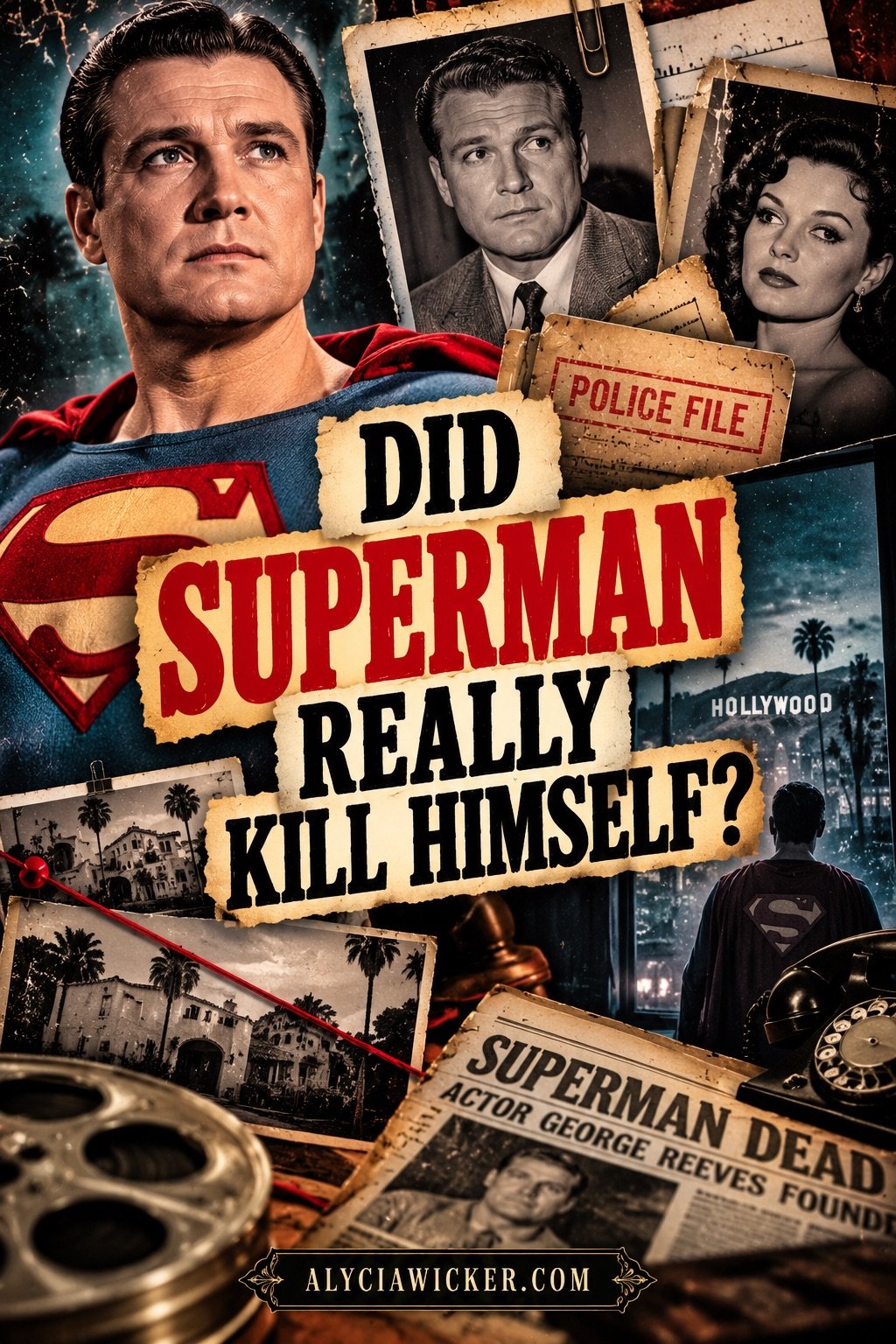
George Reeves went upstairs to bed sometime after one in the morning on June 16, 1959. Normally, a grown man going to bed in his own house would not become an important part of American history. But while George was upstairs, his fiancée, Leonore Lemmon, reportedly told the people still drinking downstairs that he was going to shoot himself. Then she apparently announced that he’d opened the drawer where he kept his gun. Then everybody heard a gunshot.
A few minutes later, George Reeves—the man millions of people knew as Superman—was found naked and dead on his bed with a gunshot wound to his head. He was 45 years old. There was a German Luger on the floor near his feet, no suicide note, and four people downstairs who had just watched his fiancée suddenly turn psychic with such remarkable clarity that somebody should’ve hired her for that fucking psychic CIA program.
Police determined that Reeves had killed himself, and his death was officially ruled a suicide. And listen, that absolutely could be what happened. But then you start digging into this thing and it’s like buying a house where the realtor says, “There’s just one little issue with the plumbing,” and six hours later you’re standing knee-deep in sewage wondering why nobody mentioned the foundation is also sinking. Because Leonore’s premonition is merely where the weird shit begins.
There were other bullets fired in the bedroom. There were bruises on George’s body. There were questions about the evidence that was—and wasn’t—collected. His mother didn’t believe he’d killed himself. His former girlfriend apparently didn’t believe it either, which becomes a hell of a lot more interesting when you find out who she was married to.
But before we get to MGM’s resident problem solver, we need to talk about George.
Superman Was Great for George Reeves Until It Wasn’t
George Reeves had already been kicking around Hollywood for years before he put on the cape. He studied acting at the Pasadena Playhouse, landed a small role in Gone With the Wind, served during World War II and went back to acting afterward. Then Adventures of Superman came along in the early 1950s and made him famous. Really famous. Kids adored him, he became instantly recognizable, and suddenly George Reeves and Superman were basically the same person as far as much of America was concerned.
Which sounds fabulous until you’d like to play literally anybody else.
Reeves became frustrated with being typecast, and after his death that frustration became a major part of the suicide narrative. The story hardened into something like this: poor George couldn’t escape Superman, his career was over, he became despondent and killed himself.
There’s some truth buried in there. He really did have career frustrations. But his life wasn’t a smoking crater. There were discussions about more Superman, he had interests in directing and other work, and he was engaged to Leonore. None of that proves he wasn’t suicidal, because that’s not how human beings work. You can have plans for Thursday and still be in terrible shape on Tuesday.
It does mean we should probably resist tying a little bow around the man’s entire psychological state because he didn’t enjoy being typecast.
Especially once we see what happened inside his house.
So What the Hell Happened That Night?
George and Leonore had been out earlier that evening and returned to his home in Benedict Canyon. Writer Robert Condon was staying there while working on a story about George. Eventually George went upstairs to bed, presumably believing the evening was over.
It was not.
Sometime after midnight, William Bliss and Carol Van Ronkel showed up at the house. George came back downstairs wearing a bathrobe and apparently wasn’t thrilled that his house had turned into an after-hours lounge while he was trying to sleep. There was some arguing, eventually everybody settled down, and George went back upstairs.
And that’s when Leonore apparently discovered her remote-viewing abilities.
She reportedly said George was going to shoot himself. Then, according to accounts of the night, she said he’d opened the drawer where he kept his gun and indicated that the shot was coming.
Bang.
Leonore later told police she’d been joking.
Ma’am.
And to be fair to Leonore, maybe she was. She knew George. She knew he’d been drinking. She knew he was pissed off. She apparently knew where the gun was kept. A dark joke with catastrophically bad timing is completely possible.
But I don’t care who you are, if somebody says, “He’s getting the gun now,” and then a gun goes off upstairs, you’re going to remember that shit.
William Bliss ran upstairs and found George on the bed. The bullet had entered his right temple, passed through his head and ended up in the ceiling. The Luger was on the floor near his feet.
At first glance, there’s your answer.
Then somebody looked under the rug.
Oh Good, More Bullets
Investigators found two additional bullet holes in the bedroom floor beneath a rug. One of the bullets had gone through the floor and ended up near the fireplace downstairs. Leonore reportedly explained one of the old shots by saying she’d accidentally fired the Luger while fooling around with it a few days earlier.
Which is certainly a sentence.
The important thing here is that old bullet holes don’t prove anybody murdered George Reeves. If Leonore accidentally fired the gun earlier, then she accidentally fired the gun earlier. People have been doing spectacularly stupid shit with firearms for as long as firearms have existed.
But there were two old shots, and one wasn’t clearly explained.
So now we’ve got George dead from a gunshot, two additional bullets fired in the same bedroom, and the woman downstairs who apparently knew exactly what was about to happen.
Then we get to the investigation itself, which isn’t exactly going to make anybody feel better.
No identifiable fingerprints were recovered from the gun. George’s hands weren’t tested in the way we’d expect today to determine whether he’d recently fired it. His body had been washed before the autopsy. Bruises were found on him, including injuries that would later help fuel theories that there had been some kind of struggle. The people who’d been in the house weren’t perfectly consistent about who went upstairs, when they went upstairs and what happened in the bedroom before police arrived.
Now, I’m not going to pretend a 1959 crime scene should look like an episode of CSI. Different time, different procedures. But that’s precisely why we’re screwed now. Whatever wasn’t collected or tested in 1959 isn’t sitting in an evidence locker waiting for somebody with better technology and a true-crime podcast to solve it.
It’s gone.
And right about here, when you think we have plenty to work with already, George’s love life kicks the door open.
George Had Been Sleeping With a Married Woman
Before Leonore, there was Toni Mannix.
George and Toni had a long-running affair, and apparently nobody involved was going to win an award for discretion. Toni was married to Eddie Mannix, but Eddie knew about George. Toni showered George with gifts and reportedly bought him the Benedict Canyon house where he would eventually die. This wasn’t some three-week fling conducted through burner phones. Toni and George were together for years.
Eventually George ended the relationship and moved on with Leonore.
Toni was reportedly devastated.
Under normal circumstances, we’d file this under Messy Hollywood Relationship and continue with our lives.
Unfortunately, Toni’s husband was Eddie Mannix.
And Eddie Mannix was a man you called when you had a problem.
Meet Eddie Mannix, MGM’s Fixer
This is where old Hollywood gets so much more interesting than the sanitized version where everybody wore beautiful clothes and went to premieres.
The big studios didn’t merely make movies. They manufactured people. Actors had carefully managed public images, and when one of those actors did something inconvenient—an affair, an arrest, a pregnancy, a drunken disaster, whatever might scare the advertisers or get somebody’s face splashed across the newspaper—the studio had an entire machine designed to deal with it.
Eddie Mannix was part of that machine at MGM. He rose to become a powerful executive, but he also developed a reputation as one of the studio’s fixers: somebody who knew how to work behind the scenes when MGM had a situation it didn’t particularly want becoming tomorrow’s headline. That world involved publicity departments, lawyers, friendly relationships with law enforcement and reporters, favors, pressure and the general understanding that Hollywood looked glamorous partly because there were people whose job was cleaning up the shit before the public smelled it.
So let’s review.
George Reeves had been having a years-long affair with Toni Mannix.
Her husband knew.
George dumped Toni and got engaged to another woman.
Toni reportedly took the breakup very badly.
And Toni’s husband was a powerful Hollywood fixer whose professional life included making unpleasant situations disappear.
Then George ended up dead.
From a gunshot.
In the house Toni reportedly bought him.
And his death was quickly determined to be a suicide.
Well, fuck.
This does not mean Eddie Mannix had George Reeves killed. There has never been physical evidence establishing that, nobody was charged with George’s murder and the suicide ruling has never been overturned. But now you understand why Eddie’s name didn’t get dragged into this story because some guy on Reddit got bored one night. He’s sitting directly in the middle of George’s personal life.
And somehow Toni manages to make this even weirder.
Toni Apparently Thought George Was Murdered
Phyllis Coates, who played Lois Lane opposite George, later recalled receiving a phone call from Toni on the morning George died. According to Coates, Toni was distraught and said George had been murdered.
That’s interesting enough.
Then publicist Edward Lozzi came along with a much bigger story. He claimed that years later, when Toni was elderly, he witnessed her confess to a priest that she and Eddie had been responsible for George’s death.
Now, before we start measuring Eddie for his orange jumpsuit approximately sixty years too late, there are problems with this. We don’t have Toni’s confession recorded. We don’t have independent evidence proving the alleged confession happened exactly as described. These stories surfaced years after George’s death.
But Jesus Christ, Toni.
At this point we’re supposed to believe the girlfriend downstairs accurately predicted George’s suicide immediately before the gunshot while the former girlfriend was apparently telling people afterward that he’d been murdered, and the former girlfriend happened to be married to MGM’s fixer.
Maybe everybody involved in this story just had absolutely incredible intuition.
Perhaps I should be taking notes.
George’s Mother Wasn’t Buying It Either
George’s mother, Helen Bessolo, did not believe her son had killed himself. She hired prominent Hollywood attorney Jerry Giesler and pushed for further investigation, including additional examination of George’s body.
And I think this matters because the questions about George’s death didn’t materialize thirty years later after somebody decided Superman needed a conspiracy theory. His mother was challenging the suicide determination almost immediately.
But here’s where we have to keep our feet on the ground: after looking into the case, Giesler ultimately concluded there wasn’t enough evidence to challenge the official determination. George’s friend and Superman co-star Jack Larson believed George had killed himself. No homicide case was established. Nobody was charged. The official finding remained suicide.
Which is frustrating as hell, because every time this story hands us something that feels like we’re getting somewhere, it hands us something else that sends us straight back to the beginning.
So Did George Reeves Really Kill Himself?
Maybe he did.
That’s not me being coy. Suicide remains the official determination, and there are perfectly reasonable ways to construct that version of events. George had been drinking. He was angry that night. He had experienced professional disappointments. Leonore knew him well enough to recognize what he might do upstairs. The old bullet holes may have had nothing whatsoever to do with his death. Eddie Mannix may simply be the world’s most unfortunate husband to have sitting adjacent to a mysterious Hollywood death.
You can explain almost every strange piece of this story.
The problem is how many pieces need explaining.
Leonore’s psychic fucking play-by-play can be a terrible joke. The extra bullet holes can be unrelated. The bruises can have an innocent explanation. The missing forensic evidence might not have changed anything. Toni’s alleged comments can be unreliable. Eddie’s fixer reputation can be an irrelevant coincidence. George’s mother can simply have been a grieving woman who couldn’t accept that her son had killed himself.
All of those things are possible.
But put them in the same house, attach them to the same dead man and suddenly “George Reeves killed himself” stops feeling like the end of the story. It becomes one of the possible explanations for everything sitting around it.
George spent years playing a man who could see through walls. More than sixty years later, the rest of us are still trying to see through one bedroom in Benedict Canyon.
I Took This One to the Cards
Did Superman Really Kill Himself? The Mysterious Death of George Reeves
I took the questions the official record can’t answer to the cards and looked at what may have actually happened that night. The full George Reeves investigation is inside Moon Moth Manor.
Join the Manor, then search “George Reeves” in the Video Vault to watch.