Crystals for Grief When Nothing Else Helps
Grief has a way of making most spiritual language feel useless.
People tell you it gets better. They tell you your loved one is at peace. They tell you everything happens for a reason. None of that helps when the loss is still sitting in your chest like a weight you can’t shift no matter how you breathe.
Grief is not a mindset problem. It’s not something you fix with perspective. It’s an experience that lives in the body as much as it does in the heart, and that’s why so many well-meaning suggestions fall flat. They aim at the mind when the pain isn’t living there.
This is usually the point where people either give up on spiritual support entirely or reach for something tangible. Not because they believe an object will heal their grief, but because they need something that doesn’t require words.
Why Grief Needs Grounding, Not Meaning
One of the hardest parts of grief is that it strips away your ability to make meaning in the usual ways. Things that once felt comforting or insightful suddenly feel hollow. Your system is busy trying to survive the loss, not interpret it.
Grief doesn’t want explanations. It wants stability.
This is why grounding matters so much during loss. Not grounding in the sense of “staying positive” or “raising your vibration,” but grounding in the literal sense of staying present in a body that feels like it’s been cracked open.
When grief is fresh or overwhelming, subtle, physical forms of support tend to land better than abstract reassurance.
Why Crystals Can Help When Words Can’t
Crystals don’t help grief by fixing it. They help by giving the body something steady to return to.
Grief often makes people feel unmoored. Sleep is disrupted. The nervous system stays on edge. Emotions arrive without warning and leave just as unpredictably. Having something physical to hold, carry, or sit near can create a small sense of continuity when everything else feels unstable. Some people find comfort in having a small, grounding stone nearby during periods of grief.
This isn’t about believing a stone will take your pain away. It’s about having a quiet anchor when your system needs one.
Sometimes that’s enough for the moment.
What Crystals Are Not Meant to Do During Grief
This matters, because grief already comes with enough self-blame.
Crystals are not meant to:
make you “move on”
numb your emotions
speed up healing
turn loss into a lesson
If you’re using them expecting relief or resolution, disappointment is likely. Grief doesn’t resolve on a schedule, and no tool can make it do so.
What crystals can do is support regulation. They can help the body feel a little safer while grief runs its course.
Some Crystals People Commonly Choose During Grief
These aren’t prescriptions. They’re patterns I’ve seen over time — what people reach for when they don’t want platitudes or pressure to feel better.
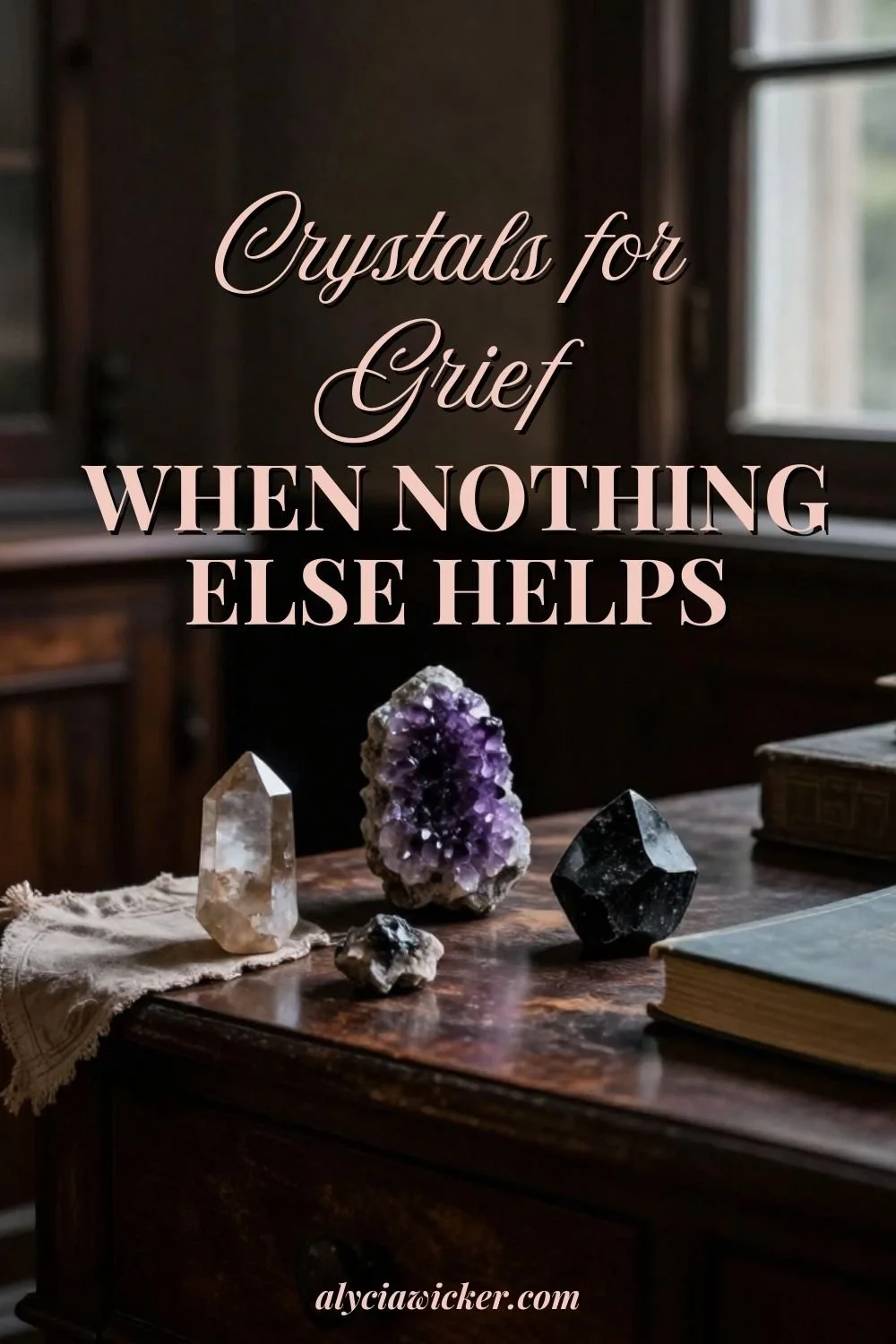
Often chosen for its grounding quality. People like it when their thoughts feel heavy or scattered and they need something stabilizing that doesn’t amplify emotion.
Tends to appeal to people who feel raw or exposed. It’s often described as supportive when someone wants boundaries rather than comfort.
Apache Tears (Obsidian)
Despite the dramatic name, this one is usually chosen for its quietness. People reach for it when they want acknowledgment of grief without being pushed toward catharsis.
Frequently associated with emotional regulation rather than emotional release. Some people find it helpful when grief comes with anxiety, restlessness, or nervous system fatigue.
Moonstone (in small, subtle forms)
Not for everyone, but some people choose it when grief feels cyclical or unpredictable. This isn’t about intuition or insight — more about allowing fluctuation without judgment.
The common thread here isn’t symbolism. It’s tone. These stones are chosen because they don’t demand engagement. They don’t try to cheer anyone up. They don’t promise progress.
What Matters More Than the Stone
If someone is grieving, the specific crystal matters far less than how it’s used.
If it sits nearby while someone gets through the day, it’s doing enough.
If it gives their hands something solid to hold, it’s doing enough.
If it exists without commentary, it’s doing enough.
Anything that makes grief feel like a project has already missed the point.
Crystals That Tend to Support Grief Gently
Different people respond to different things, but there are certain qualities that tend to be more supportive during loss: grounding, softness, emotional containment, and steadiness.
Crystals that people often reach for during grief are ones associated with:
grounding and stability
emotional processing
gentle comfort rather than stimulation
These are not “high energy” stones meant to push transformation. They’re chosen for their quiet presence, not their intensity.
The goal isn’t to feel better. It’s to feel held.
Why Subtle Support Matters More Than Dramatic Change
Grief already brings enough intensity. What most people need is not another overwhelming experience, but something that doesn’t demand anything from them.
Subtle support often shows up as:
slightly easier breathing
feeling marginally less scattered
having something familiar nearby during waves of emotion
These changes don’t feel impressive. They don’t make good testimonials. But they matter when you’re just trying to get through the day.
Grief doesn’t need fireworks. It needs patience.
When Crystals Aren’t Enough (And That’s Okay)
There are moments in grief when grounding alone isn’t enough. When the loss raises questions that won’t quiet down. When confusion, guilt, or unfinished business sit heavier than the sadness itself.
In those moments, support often needs to shift from regulation to understanding. Not explanations meant to justify the loss, but clarity around what’s being felt, what’s unresolved, or what’s still present energetically.
Knowing when you need grounding versus when you need perspective is part of caring for yourself through grief. Sometimes a gentle, intentional reading can help bring clarity to what feels unresolved.
Grief Isn’t a Problem to Solve
This is the part people don’t want to hear, but need to.
Grief doesn’t mean you’re doing something wrong. It doesn’t mean you’re stuck. It doesn’t mean you’re failing at healing.
It means you loved something deeply, and your system is adjusting to its absence.
Crystals can offer quiet companionship during that process. They can’t carry it for you, but they can sit with you while you carry it yourself.
And sometimes, that’s enough for now. If you’re navigating grief and want supportive clarity rather than platitudes, you can explore my current reading options here.